
Transportation AI Policy Tracker
A maintained scoring of every major US transportation agency's published AI policy posture. Installment 1: state DOTs. Updated quarterly.
A maintained scoring of every major US transportation agency's published AI policy posture.
What this is
Most working PEs and PMs on federal-aid transportation projects don't know which layer of policy actually governs their AI use. The contract is one layer. The state DOT's policy is another. The federal preemption layer is a third. The Tracker is the lookup table.
The Tracker covers four layers, in order of installments:
| Installment | Layer | Status |
|---|---|---|
| 1 | State DOTs (50 states + DC + Puerto Rico) — 52 entities | Live |
| 2 | Federal transportation agencies (USDOT, FHWA, FAA, FTA, FRA, NHTSA, FMCSA, MARAD, USACE Civil Works) — ~9 entities | June 2026 |
| 3 | Major transit authorities (MTA, WMATA, LA Metro, BART, MBTA, CTA, SEPTA, Sound Transit) — ~8 entities | August 2026 |
| 4 | Multi-state, port, toll, and MPO authorities — ~15 entities | October 2026 |
| Quarterly refreshes from Q1 2027 onward. | ||
Headline findings (state DOT layer)
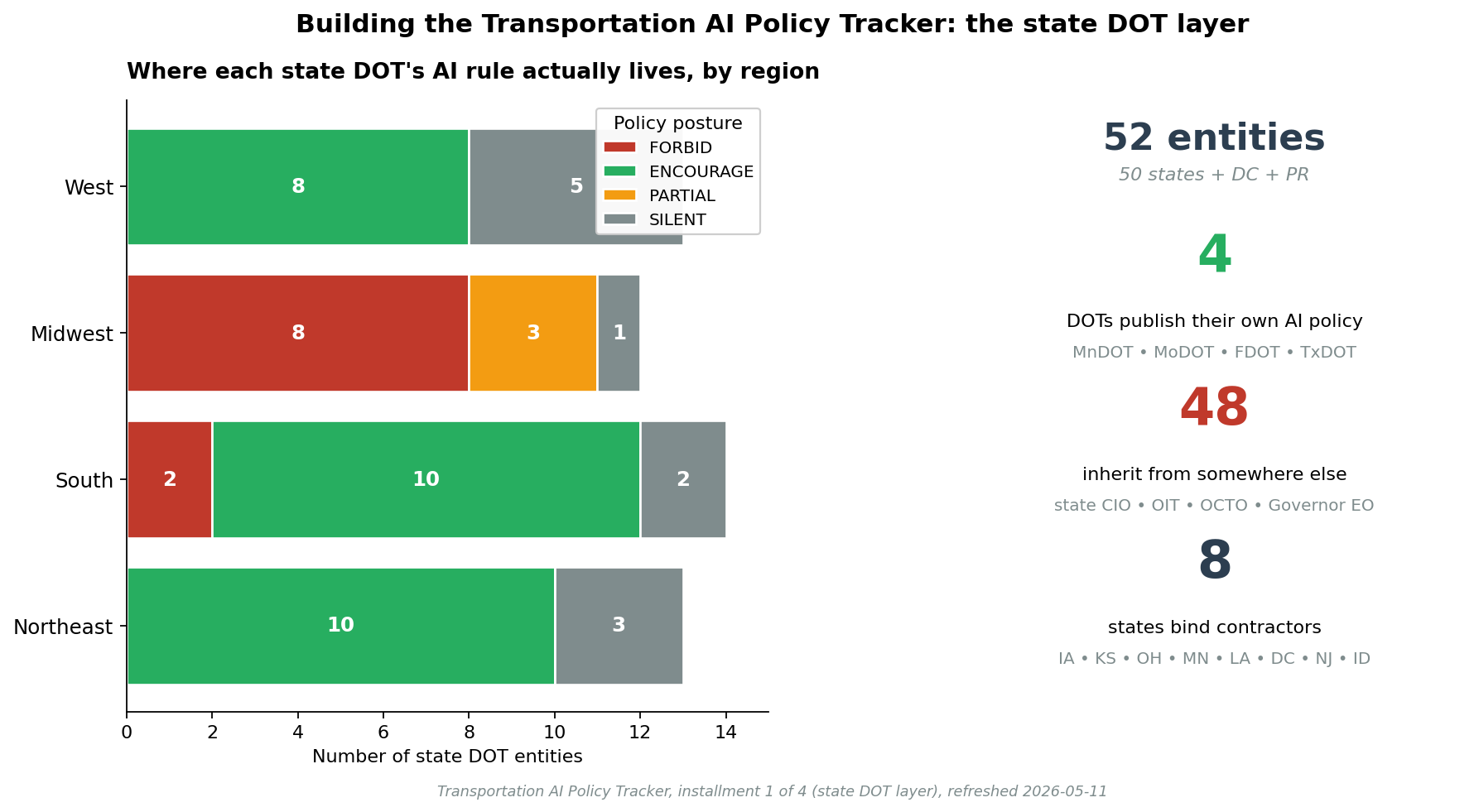
- 52 entities surveyed (50 states + DC + Puerto Rico).
- 10 FORBID / 28 ENCOURAGE / 3 PARTIAL / 11 SILENT.
- Only 4 DOTs publish their own AI policy — MnDOT, MoDOT, FDOT, TxDOT.
- 48 of 52 inherit from state CIO, OIT, OCTO, or Governor EO.
- 8 states extend AI rules to contractors — Iowa, Kansas, Ohio, Minnesota, Louisiana, DC, New Jersey, Idaho.
Updated 2026-05-11: Idaho reclassified from SILENT to ENCOURAGE after Mike Copeland flagged that the state's AI-PSG (Aug 2025) had been missed. See CORRECTIONS.md in the repo for the full change log.
Source data
The full source dataset, methodology, and per-region reading notes live in the GitHub repo: github.com/JosephD130/transportation-ai-policy-tracker
You can:
- Read every entity's verbatim operative clause
- Fork the dataset and rerun the analysis
- Open an issue if your state's classification looks wrong
- Open a PR with corrections
- Suggest non-state agencies for installments 2-4
How to use this on a federal-aid project
Four steps, in order:
- Find the contract's AI clause first. Silence is not permission.
- Look up your state in the Tracker. It tells you whether the operative rule lives at the DOT, the state CIO, or the Governor's EO.
- Check the federal preemption layer. OMB M-25-22 + downstream agency guidance. Installment 2 covers this.
- If the consultant question is unanswered, default to no-cloud-uploads. Use on-prem or local models, redacted prompts, or get written contracting-officer permission.
About
The Tracker is published by Joseph Dib, P.E., PMP, through Infrastructure Catalyst, the newsletter that thinks out loud about AI in civil and transportation work.
Subscribe to follow the launch arc and the quarterly refresh.
Cite as: Joseph Dib, Transportation AI Policy Tracker, Infrastructure Catalyst, 2026.
Last updated: 2026-05-11